
Export rights book cards
English book introductions and rights consultation materials for the three FDE volumes and Zhuge Liang book
DOCX · English · 1.7 MB
Download resource“Academic book support policies must change from supporting publication costs to supporting utilization.”
A strategy document for participation in the National Assembly forum, “Supporting Academic Books to Revitalize Higher Education in the AI Era,” held on August 10, 2026. It presents the publishing portfolio built by Jinhan M&B and Jaiwoo Shim as a practical knowledge ecosystem connecting publishing, education, qualifications, and industry.
The biggest meaning of this event is not the opportunity to sell three books; The K-FDE knowledge ecosystem that connects ‘publishing – education – qualifications – industry’ can be presented as a public agenda. no see.
“In the AI era, strengthening young people’s literacy and right to learn, and continuing to support the knowledge ecosystem”

Click to view in original size.
| subject | Exploring ways to support academic books to revitalize higher education in the AI era |
|---|---|
| subtitle | In the AI era, strengthening young people’s literacy and learning rights, and continuing to support the knowledge ecosystem |
| participation | CEO Gapyong Kim — Jinhan M&B CEO qualification, panel discussion |
| main attendance | Members of the National Assembly, Academic Publishers Association, Science and Technology Publishers Association, University Publishers Association, University Education Council officials |
System design that extends support centered on publication costs to planning, writing, publishing, textbook adoption, digitization, AI connection, curriculum, field application, and revision.
Publication of specialized books → Curriculum operation → Project practice → Competency certification → Corporate field placement → Accumulation of cases → Publication of revised edition.
A new literacy standard that goes beyond text understanding and includes questioning, structuring, AI explanation, result verification, and problem solving.
Building an educational environment that includes academic book-based projects, microdegrees, and AI tutors.
Statements that focus on raising issues such as “AI is replacing publishing” and “the academic book market is difficult” and demanding increased support for publication costs.
Presenting “How academic books will create education and vocational competencies in the AI era” as a policy model along with actual publication examples.
caution - It is recommended to avoid directly promoting the KFDE Association or private qualifications during National Assembly debates. Since it is still in the establishment/registration stage, ‘Model based on published books’ or ‘A new case linking publishing and education’It is appropriate to introduce it as .
The collaboration between Jinhan M&B and author Jaiwoo Shim is not a simple author-publisher relationship. Activities to build a long-term knowledge ecosystem that connects future education, literacy, science and culture, AI, entrepreneurship, and social innovation no see. This is not the result of publishing several books by chance, but rather how the talent needed in the AI era should grow. This is a publishing and education roadmap that has been accumulated step by step.
 Reading method of Nobel Prize winners: 3-color line reading2023.07 · 304 pages
 15 creative questions asked by Nobel Prize winners2025.01 · 414 pages
 Follow the writing secrets and know-how of Nobel Prize winner Han Kang2025.03 · 270 pages
 Prompt question technology that utilizes ChatGPT 200%2023.04 · 356 pages
 Metaverse Future School2022.07 · 360 pages
 High School Credit System Meta Campus2023.05 · 452 pages
 Nobel Gifted Talent and Global Education Revolution through Franchising2025.07 · 294 pages
 A guidebook for designing 55 future jobs for middle and high school students and job seekers2024.05 · 308 pages
Prompt question technology that utilizes ChatGPT 200%2023.04 · 356 pages
 The era of entrepreneurship created through words2026.05 · 312 pages
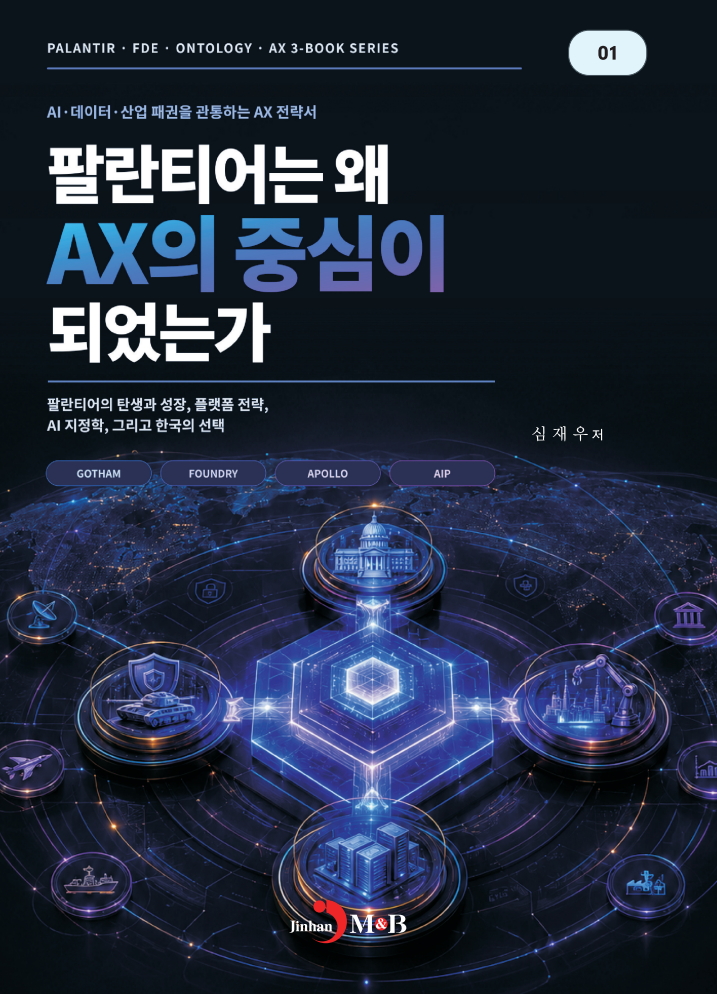 Volume 1 Why Palantir became the center of AXStrategy · Published
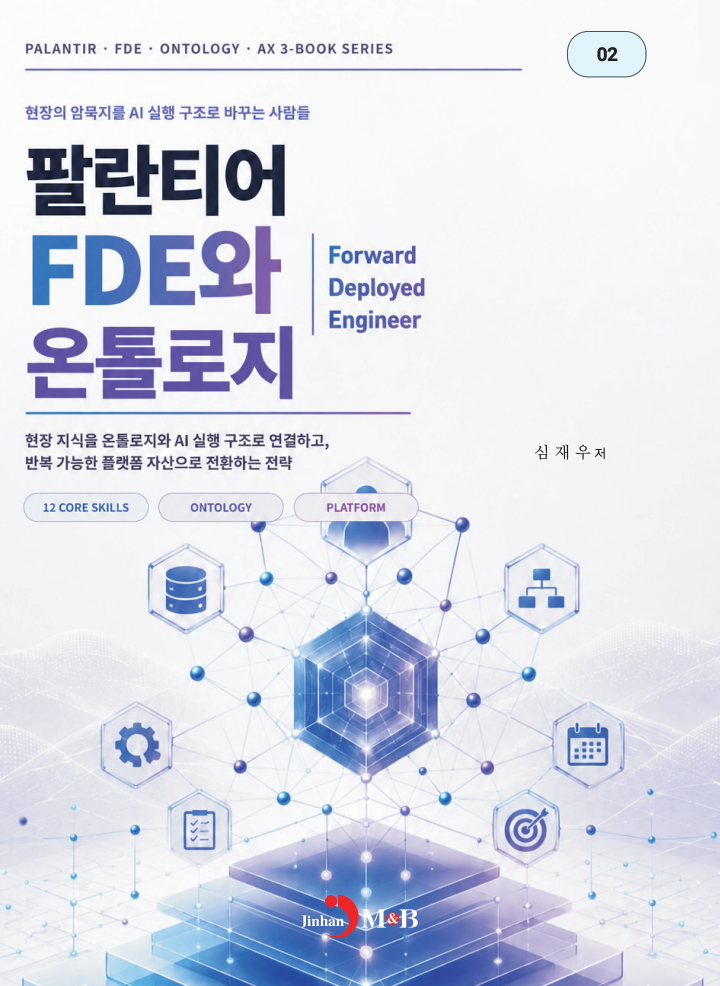 Volume 2 Palantir FDE and OntologyDesigned and published
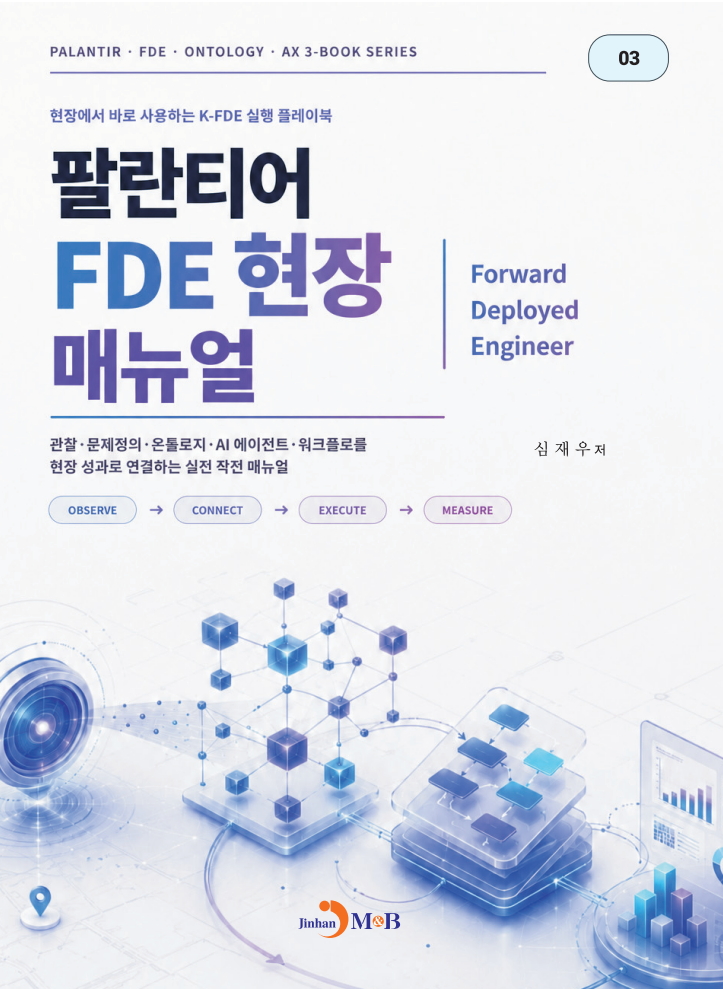 Volume 3 Palantir FDE Field ManualImplementation · Published
 How to appreciate art exhibitions 100 times more2025.04 · 146 pages
 The secret of Hanji, paper that lives for a thousand years2025.06 · 262 pages
 The Secret of Petroglyphs, Rocks That Live for Thousands of Years2025.09 · 218 pages
 rebellion of dots2025.11 · 464 pages
 K-culture gains wings with AI docent2025.05 · 320 pages
“From readers to questioners, from questioners to knowledge creators, From a person who creates knowledge to a person who designs the future, from a person who designs the future “We create it ourselves with AI and grow into people who change the field.”
“Read, ask questions, write, plan the future, create it in words, and implement it in the field.”
— One sentence summary
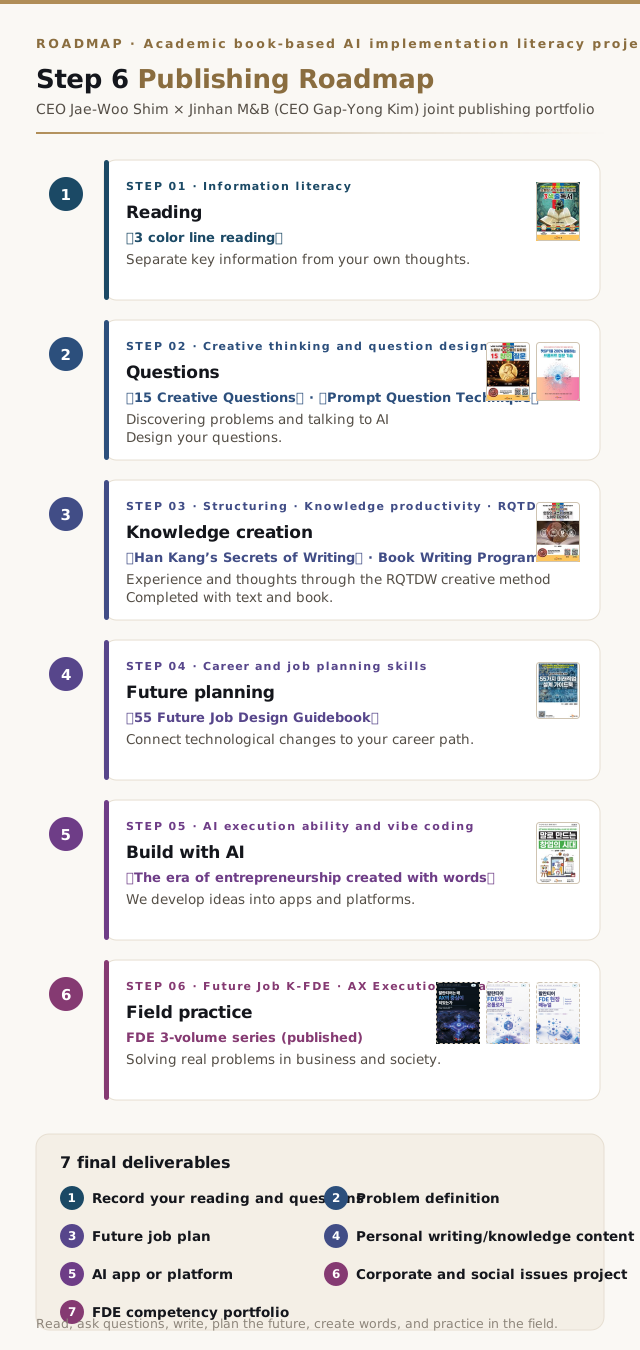
By linking books that have already been published, there is no need to create a new educational model from scratch. Each step is an input to the next step 6-step growth path is already built.
Active reading: distinguishing information, identifying key points, and forming your own thoughts.
Creative thinking to explore new possibilities and design questions to communicate with AI.
Analyzing the creative secrets of Nobel Prize winner Han Kang RQTDW (Read–Question–Think–Design–Write) creative methodology By, Knowledge productivity that logically structures experiences and thoughts and completes them into one knowledge asset.
Future capabilities to understand changes in technology and society and design jobs and roles needed for the future.
AI execution ability that explains ideas in words and natural language and implements them into applications, platforms, and start-up items. A key link between 『55 Jobs of the Future』 and the FDE 3-volume series. ‘Bridge of Execution’.
By discovering problems in the field and connecting ontology, data, AI agents, and vibe coding, AX implementation capabilities that translate into corporate and organizational performance.
Detailed step-by-step details of the 6-step roadmap can be found on separate pages — View roadmap page →
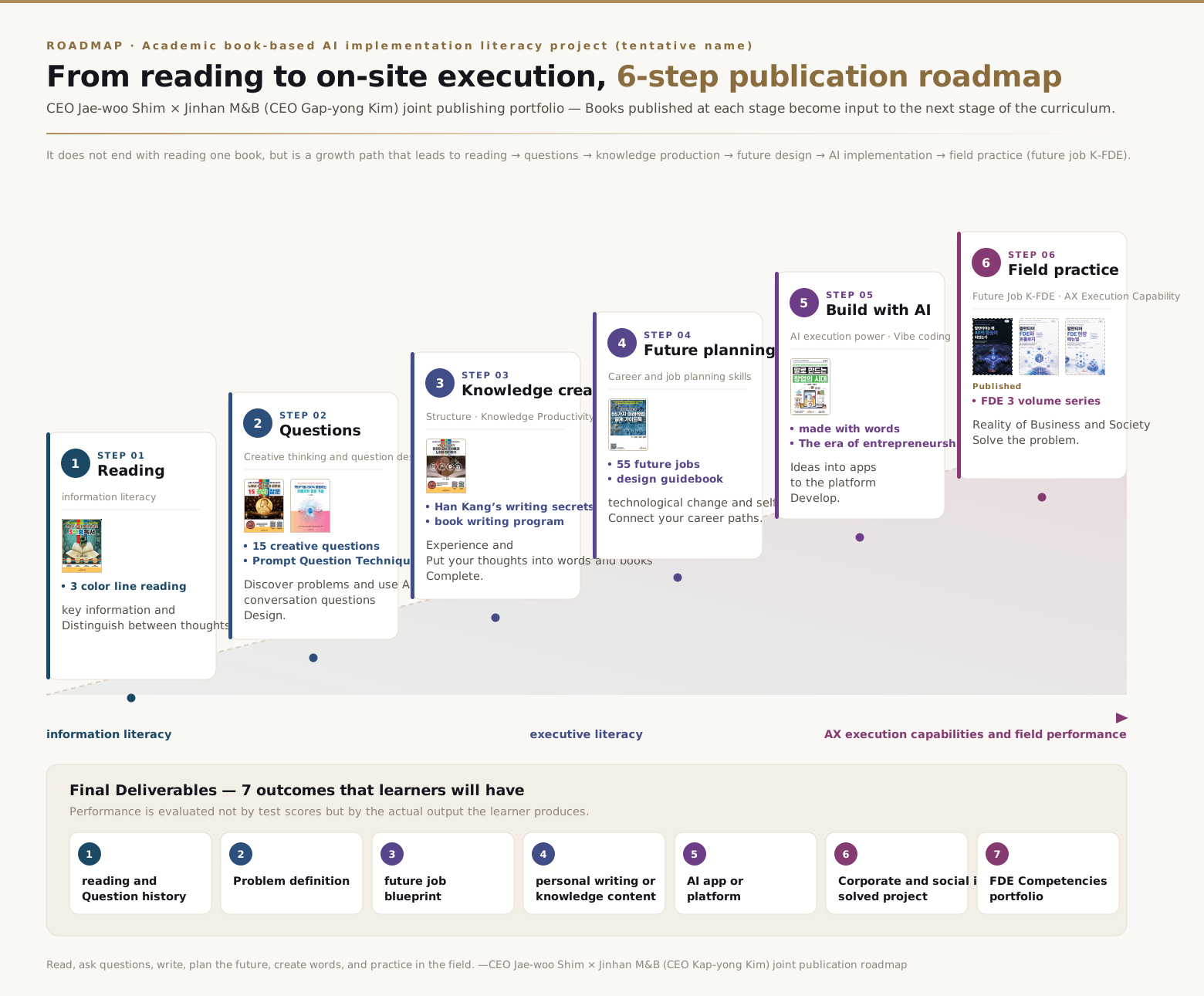
Chart file: roadmap.svg (width) · roadmap-vertical.svg (length)
Vibe Coding is not just a coding technique. Lowers the barrier to coding but emphasizes the importance of literacy and thinking skills. It doesn't lower it. Rather, what to build, whose problems to solve, How to describe required functions and business rules has become more important.
“Literacy in the AI era goes beyond the ability to read and understand, but to question, structure, and “We need to develop implementation literacy skills to explain our ideas to AI and implement them into actual results.”
The FDE three-volume series is not a separate new publishing venture. The literacy, question, knowledge production, future education, and AI implementation publishing portfolio that has been built for a long time Completion stage that extends to AX implementation in companies and industrial sites no see.
| volume | book | function | education linkage |
|---|---|---|---|
| Volume 1 strategy |
Why Palantir became the center of AX | A strategy book to understand AX and Palantir | AX Leadership Course Strategy Workshop |
| Volume 2 design |
Palantir FDE and Ontology | A professional book summarizing the role and core competencies of FDE | Framework design process Advanced Course |
| Volume 3 execution |
Palantir FDE Field Manual | Practice and implementation textbooks applied in the field | Field practical course Vibe Coding Practice |
If you connect the three books to K-FDE Academy education and private qualifications, it is not just a book series. The key topic of the discussion meeting ‘Academic book support’ and ‘knowledge ecosystem virtuous cycle’ can be shown as actual business models.
An academic book ecosystem cannot be created by publishers alone.
When CEO Gapyong Kim's publishing and academic network is combined with CEO Jaiwoo Shim's corporate education, FDE, and AI platform development capabilities, Partnership to jointly design a new AI talent training ecosystemcan develop into.
Do not stop at raising the issue that “publishing academic books is difficult”; Redefinition as a matter of structure You must do it.
Currently, academic book support is mainly focused on the writing and publication stages. However, after the book was published, it was widely used in university lectures, extracurricular education, projects, employment, and corporate settings. Follow-up support is lacking. As a result, even if a good academic book is published, the following problems arise.
“The crisis in academic books is not just caused by the failure to publish books. It occurs because there is no structure in which published books are read, taught, used, and revised again.”
Rather than reading the entire book, students are asking generative AI questions and getting summarized answers. In this process, the knowledge accumulated by academic book authors and publishers is utilized, Authors and publishers may not receive fair compensation. At the same time, AI answers have the following risks:
thus Rather than saying “let’s prevent the use of AI,” “verified academic books can be used as a reliable way to use AI.” “Let’s make it knowledge-based.” must offer an alternative.
“In the AI era, the role of academic books should change, not decrease. Academic books should be a source of verified knowledge for AI to refer to. Authors and publishers should be fairly compensated for their use.”
Much AI training focuses on creating prompts and utilizing features. But the key to using AI well isn't just how to use the tools.
“Literacy in the AI era goes beyond the ability to read and understand; it involves asking questions, structuring, Accurately explaining to AI, verifying results, and solving real-world problems We need to develop executive literacy.”
The most powerful central message is one — “In the AI era, it is not about supporting one book, but academic books are planned, published, educated, used AI, applied in the field, and revised. “We need to support the entire subsequent knowledge life cycle.”
Policy Name (Proposal): Academic book knowledge life cycle support project in the AI era
For an academic book to survive, publication support is essential. Use in college classes This is important.
In particular, rather than providing the same books free to all students, ‘Academic book voucher’ that allows students to select certified academic books is realistic.
“The government does not select books for them, but students choose the academic books they need. We need a way to support that purchase.”
Temporary name: Trustworthy AI knowledge platform based on Korean academic books
A trustworthy AI learning environment must be built based on academic books agreed upon by the publisher and author. When a student asks a question about a book, AI answers based on the contents of the book. This method ensures that relevant pages and sources are presented.
AI Q&A based on academic books
Answer rationale and page indication
Comparison of perspectives by author
Explanation of key concepts
Learning by level
Create quizzes and discussion questions
Learner's Question History
Link to purchase and loan the original text of the book
Compensation for authors and publishers based on usage
Core — Rather than inserting books into a general generative AI without permission, A legal knowledge utilization model with permission from the publisher and authoris to create.
“Academic books are not free raw materials for AI, but intellectual assets created over a long period of time by authors and publishers. The benefits of using AI should accrue not only to students and companies, but also to knowledge producers.”
Do not use academic books only as reading material for lectures. Starting point of project education It should be used as .
It can be applied to university extracurricular courses, capstone design, microdegree, and youth employment programs.
Temporary name: Youth AI Implementation Literacy Project
While traditional literacy education focused on reading and comprehension, the AI era must integrate the following six things: It is jointly operated by universities and publishers, and companies provide real-world problems. This is a method where students use AI to create results.
The role of each institution is Knowledge Ecosystem SectionI organized it in . The key is to create an ecosystem of academic books, not just publishers. Four-party cooperation structure is to design it.
Even young people in non-majors such as humanities, social studies, management, and education can use natural language and generative AI. We help you turn your ideas into digital products.
Theories and ideas presented in academic books can be combined with apps, platforms, and AI tutors. We support development through simulation.
Reading, questioning, structuring, writing prompts, verifying results, solving problems and creating AI. Develop new literacy standards that include:
Regardless of major, students can combine their major knowledge with AI. We provide support to develop actual services and start businesses.
It is not a panel that only answers Panel asking policy questions The goal is to become this.
“Some argue that as AI develops, academic books will no longer be needed. I think the opposite. The value of verified academic books has become more important to verify and provide context to the information generated by AI.”
“However, current support for academic books remains at the publishing stage. Books are used for university education, projects, “It is difficult for authors and publishers to sustain themselves because they are not connected to employment or industry.”
Support for the entire life cycle of academic books · Vouchers for university academic books · Trusted AI platform based on academic books · AI-utilized compensation system · Academic book-based projects and microdegrees
We introduce publishing cases that lead to reading, questions, book writing, future education, future jobs, vibe coding, and FDE.
“In the policy of supporting one academic book, it is necessary to ensure that the academic book continues to be used in education and industry. “We ask you to switch to policies that support the knowledge ecosystem.”
“Jinhan M&B has been working with author Jaiwoo Shim on 『3 Color Line Reading Method』, which deals with active reading and literacy, 『15 Creative Questions』, which deals with creative questions and thinking, a book about writing a book that turns your experience and knowledge into a book, We have published 『55 Jobs of the Future』, which deals with changes in future society and new jobs.
Recently, natural language and generative AI have been utilized to develop one's ideas into applications and platforms. We published 『The Age of Entrepreneurship Made with Words』, which is implemented as a start-up item.
Although these books cover different topics, they are connected by one path to growth. Read, ask questions, structure your thoughts, plan your future, and use AI to help you It's about implementing your own ideas.
The three-volume FDE series is now published, connecting strategy, design, and execution for professionals who solve field problems with AI and ontology.
“In the past, even if there was a good idea, it required professional development personnel, capital, and a long development period. However, with the advent of generative AI and vibe coding, you can now express your ideas and requirements in natural language. By explaining it, I was able to develop applications and platforms.
Vibe Coding lowers the barriers to coding, but it doesn't lessen the importance of literacy and thinking skills. Rather, what to build, whose problems to solve, How to describe required functions and business rules has become more important.
People with good questions, clear language, and logical structuring capabilities AI can be used to create better results. Therefore, Vibe coding education is It is not just training to use AI tools, but also literacy, problem-solving skills, and creativity. “It should be an education that develops entrepreneurship capabilities together.”
“Jinhan M&B worked with author Jaiwoo Shim on reading, questions, book writing, future education, future jobs, We have published a variety of specialized books ranging from Metaverse, ChatGPT, Vibe Coding, and social innovation.
These books are not monographs on individual topics, but rather the literacy, creativity, and It is a knowledge portfolio that develops knowledge productivity, future planning, and execution capabilities step by step.
The three-volume FDE series is now published, connecting strategy, design, and execution for professionals who solve field problems with AI and ontology.
Our experience has shown us that an academic book should not end with publication. When books are connected to curriculum, projects, AI platforms, qualifications, employment/startups, and industrial sites Only then can a sustainable knowledge ecosystem be created.”
“Currently, Jinhan M&B is focusing on FDE, a new execution talent in the AI transition era. We are preparing a knowledge ecosystem model that connects specialized books, field manuals, education, and private qualifications. “This will be an experiment in how academic publishing can connect education and industry.”
Rather than asking, “Please mention our book,” A method of providing policy messages and materials that can be used in debates This is good.
“Representative Kim, after reorganizing the books we published together, I found that this National Assembly debate There is a very consistent growth system that ties into the topic.
Reading and literacy through 『3 Color Line Reading Method』, creative questions through 『15 Creative Questions』, Knowledge production through the RQTDW creative method of 『Following Han Kang's writing secrets and know-how』, future planning through 『55 future jobs』, We have made progress in implementing AI through 『The Era of Entrepreneurship Made with Words』.
The published three-volume FDE series and K-FDE Academy extend this growth path to AX capabilities that solve real business and social problems.
To express this in one sentence, ‘read, ask questions, write, plan the future, It is a ‘talent training system for the AI era that is created with words and implemented in the field.’
In this discussion, academic books are not viewed only as publications that need to be protected, Based on books, young people can think, create, start businesses, and even solve industrial problems. “I believe that proposing a knowledge ecosystem model will create a strong differentiation in CEO Kim’s remarks.”
Attendance encouraged — National Assembly members, Academic Publishing Association, Science and Technology Publishing Association, University Publishing Association, Since officials from the University Education Council will participate, direct attendance is advantageous in forming a foundation for future cooperation.
If you speak in this direction, you will not be a panelist who only complains about the difficulties faced by the publishing industry. Policy proponent suggesting a new structure for academic publishing and higher education in the AI era It can be established as .
“The best way to protect academic books in the AI era is not to preserve them in warehouses and bookshelves. Students read books, ask questions, create their own thoughts, and implement the results with AI. It helps solve social and industrial problems.
We need more than just publishing support. Knowledge from academic books can be used in education, AI, projects, It leads to employment, entrepreneurship, and the industrial field, and the results of the field are returned in books and revised editions. It is a knowledge ecosystem.
From support for publication costs to support for use, from support for one book to We need to move to supporting the entire life cycle of knowledge.”
Download book introductions, translated prefaces, Chinese samples, and author and publisher profiles. Book-specific materials cover the three FDE volumes and the Zhuge Liang book: four titles in total.
English book introductions and rights consultation materials for the three FDE volumes and Zhuge Liang book
Chinese and English preface translation drafts for the three FDE volumes and Zhuge Liang book
Publisher introduction and international publishing collaboration · Korean, Chinese, and English
Author background, research, and publications · Korean, Chinese, and English
Four individual DOCX samples: the three FDE volumes and Zhuge Liang book
Original DOCX and ZIP files. Translations are consultation drafts and samples. Designing Your Future in the AI Era is not included in these four-book materials.